My judgment: I am not convinced Singaporeans should own cars. I am convinced my family should own one now. For this particular stage of our lives, the time, mobility and convenience were worth paying for.
Buying a car is a very personal decision.
Some might even call it trivial.
So why write about it?
Because I got triggered.
I keep seeing personal-finance advice telling Singaporeans that cars are “not worth it” because public transport is excellent and Grab is cheaper.
Hello. Where is the context?
If I am a father with young children, living at one end of Singapore and regularly ferrying my family between school, work and everything else, is Grab still obviously the better answer?
Have you tried carrying a toddler, stroller, diaper bag, bottles and God knows what else onto a packed train or bus during peak hours?
Personal finance advice without context is not advice, it is a slogan.
We already proved we could live without one
We did not immediately buy a car when our son arrived.
For his first few months, we took taxis for medical appointments. After that, we used buses and trains.
We managed.
Then our circumstances changed.
My son became a toddler. He started walking, then running, and we wanted to bring him out more—to parks, Marina Barrage and places that are perfectly accessible in Singapore but become considerably less convenient when a small expedition requires a stroller, diaper bag, spare clothes and whatever else a toddler suddenly decides he cannot live without.
His school also moved.
It used to be five minutes from home. Now it is near my wife’s workplace downtown.. and we live at the other end of Singapore.
At the same time, my wife became heavily pregnant with our second child. This pregnancy has been much more tiring than the first, and she still works in the office five days a week.
Thus, the usefulness of a car changed.
I wanted a different way of living here
The children were not the only reason.
My wife and I enjoy walking, hiking and exploring Singapore’s parks and park connectors.
The annoying part comes afterwards.
Singapore is hot.
We sweat.
If we go somewhere far from home, then want to eat before returning, we need water bottles, spare shirts, sometimes shoes and whatever else allows us to re-enter civilisation without stinking up the train.
A car solves this in a very unglamorous way - It gives us a boot.
Suddenly the stroller, clothes, shoes, bottles and random family equipment do not have to travel on our backs all day.
The car became mobile storage for the lifestyle we wanted.
It did the same for me.
I could drive somewhere different for a run.
Go to the driving range or golf without depending on friends with cars.
Stay out a little later without calculating whether the return trip was worth another cab fare.
We were also travelling less while building our family. I was drinking less and expensive dinners had largely disappeared from our lives. Some discretionary spending had naturally fallen away.
I decided to use some of that space to buy mobility instead.
Maybe Grab is cheaper. So what?
Of course I ran the numbers across ownership, Grab and public transport.
I was not trying to prove that owning a car was cheaper.
It probably isn’t.
That was not the question.
The car did not need to be the cheapest option. It needed to create enough additional utility to justify the premium.
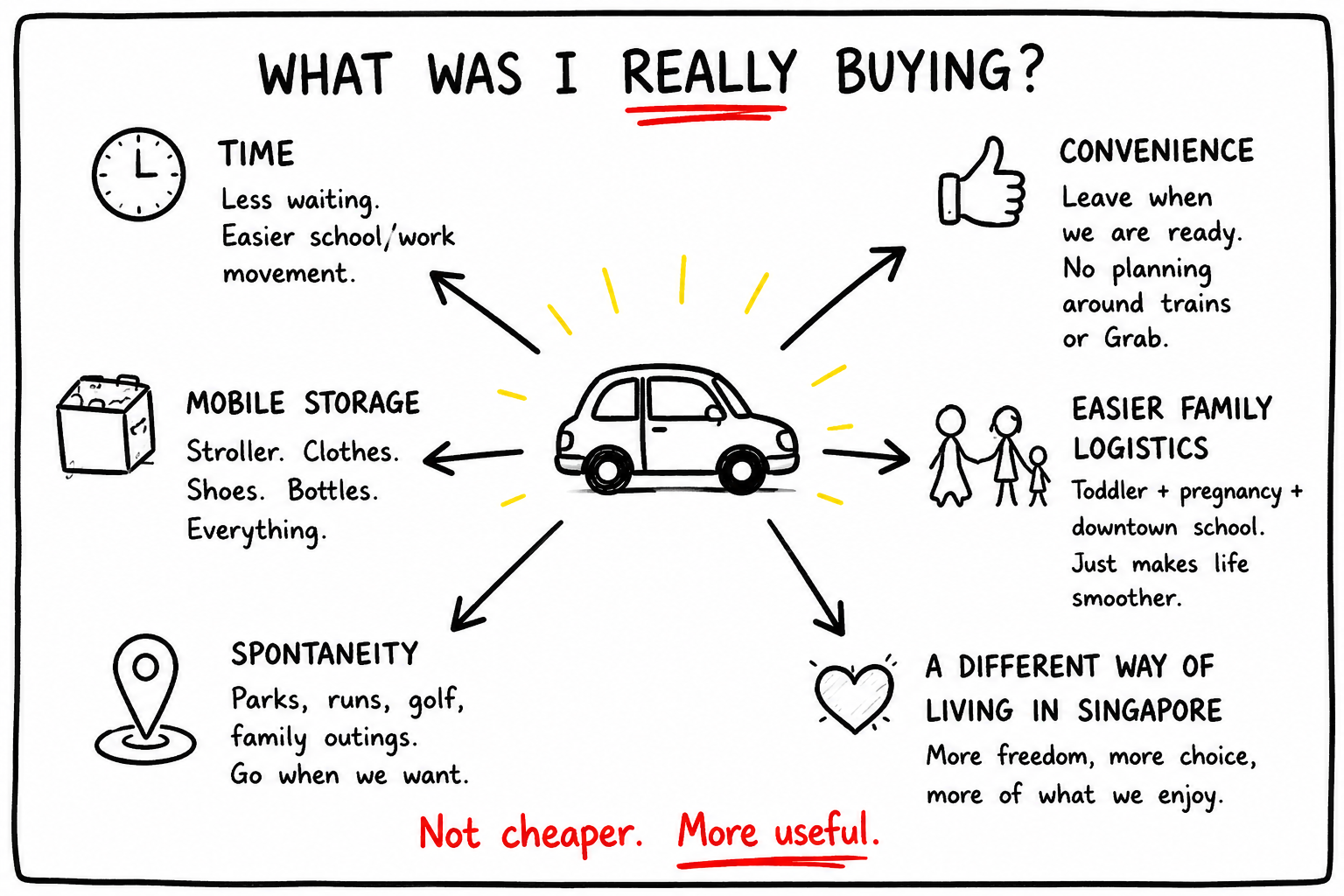
Time has value.
Convenience has value.
Being able to leave immediately has value.
Not carrying half your house around Singapore on public transport has value.
Giving my heavily pregnant wife an easier commute has value.
Being able to bring my children somewhere inconvenient on a whim has value.
Those things are difficult to fit neatly into a “Grab versus car” comparison.
But they are still real.
The car had to fit the experiment
I eventually paid about S$29,000 cash for a used car with roughly two years of COE remaining.
That was deliberate.
I was not deciding that we should become a car-owning family forever. I was buying ourselves about two years to test whether owning one genuinely improved our lives enough to justify the cost.
Two years felt long enough to answer a few questions: Will my wife become comfortable driving in Singapore? Will we actually use the car enough? Does it materially improve family life? And when our children are older and we start travelling more again, will we still want to allocate this much money to a car?
Because part of the experiment was helping my wife drive confidently here, I also wanted to reduce unnecessary variables. She already drove a 2008 Honda Jazz in Malaysia, so I looked for something similarly compact and familiar in shape and driving feel.
The rest of the criteria were intentionally boring: used, hybrid, mechanically sound, no major problems, within budget and no loan.
Buy it. Use it for two years. Then judge again.
If the context changes, so can the decision.
Did we need it?
No.
Could we have continued living without a car?
Absolutely.
There are families in Singapore with more children than us who have never owned one and manage perfectly well.
That does not invalidate our decision.
It proves the point.
Everybody’s circumstances are different. Similar perhaps. Never identical.
For this stage of our lives, we decided the convenience was worth paying for.
My point is not that buying a car in Singapore is financially smart for everyone.
It is that you should not fear it, and you should not immediately write it off as financial suicide either.
Run the numbers.
Understand the opportunity cost.
Know what you are giving up.
Then ask what you are actually getting back.
If the answer makes sense for your life, and you can afford it responsibly, then perhaps spending some money to make life better is exactly what the money is for.
We only get one life.
Live a little.
I am not convinced Singaporeans should own cars.
I am convinced my family should own one now.
And in two years, I may decide differently.
Context changes.
So should good decisions.
As always, “Think better. Live better.”