Growing up in an Asian family, I heard some version of this many times:
“Don’t take the risk.”
Usually with good intentions.
Take the stable job. Don’t borrow too much. Don’t start something uncertain. Don’t put yourself in a position where things can go wrong.
The problem is that not taking a risk does not mean there is no risk.
Keeping all your money in cash has inflation risk. Staying in one job has employment risk. Buying property has concentration risk. Investing has market risk. Starting a business has failure risk.
Risk is everywhere.
So instead of trying to avoid it, I think we should learn how to manage it.
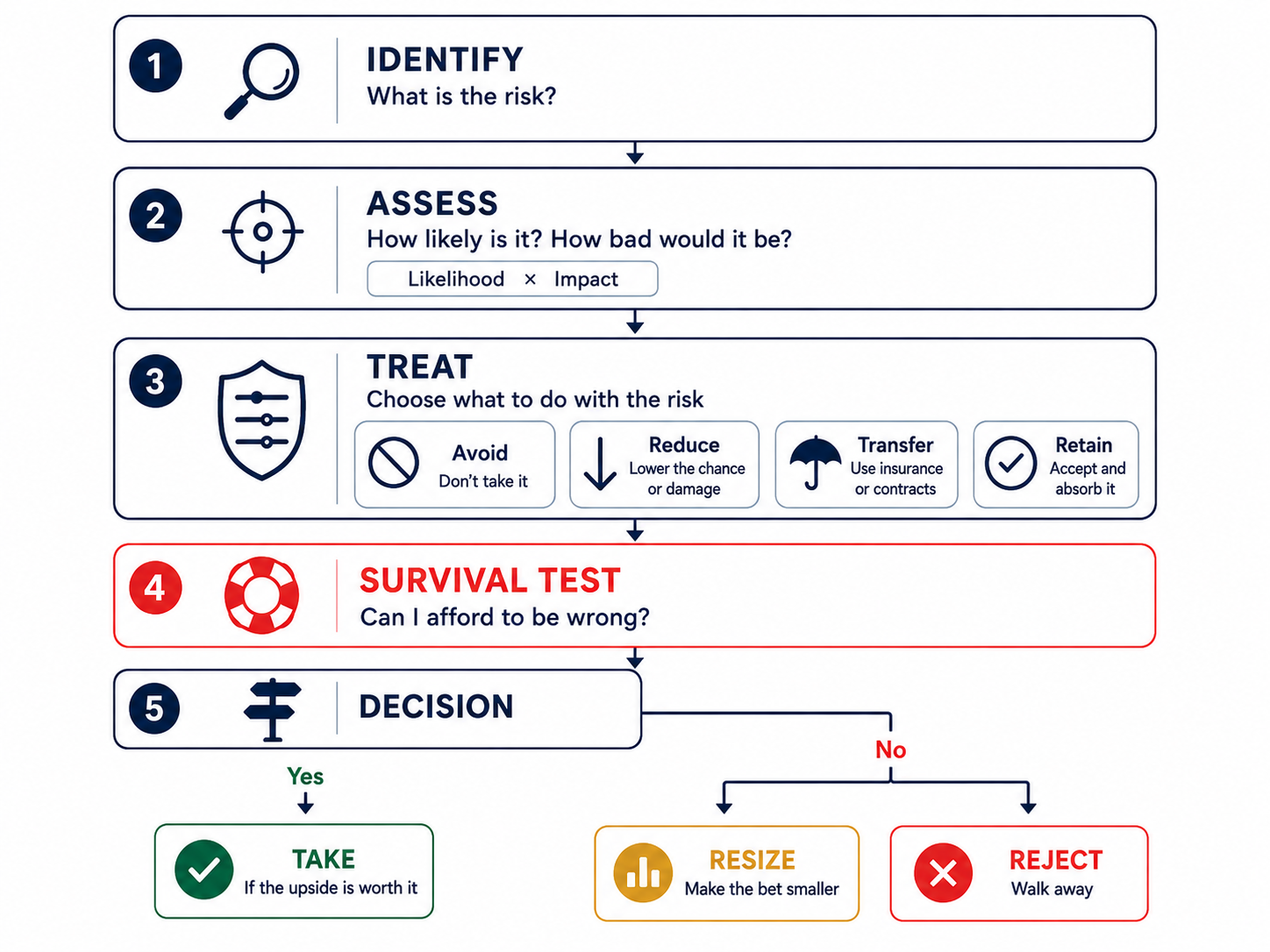
A simple framework: Identify → Assess → Treat → Survival Test → Decide (Take / Resize / Reject).
Step 1: Know what kind of risk you are taking
Not all risks are the same.
Some risks have only downside.
Your house burns down. You get seriously ill. Your car gets stolen.
Best case: nothing happens. Worst case: you suffer a loss.
This is commonly called pure risk.
Other risks have both downside and potential upside.
You invest in shares. Start a business. Change career. Buy an investment property.
You could lose.
But you are taking the risk because you could also gain.
This is commonly called speculative risk.
The distinction matters because the first type is usually something we want to protect ourselves against.
The second may actually be worth taking.
Step 2: Ask two questions
For every meaningful risk, ask:
How likely is it to happen?
And:
If it happens, how bad will it be?
A cracked phone screen may be quite likely but financially insignificant.
Your home burning down is unlikely, but potentially catastrophic.
Those two risks should not be managed the same way.
So don’t just ask:
What could go wrong?
Ask:
How likely is it, and can I absorb the damage?
Step 3: Decide what to do with the risk
There are four basic choices.
Avoid it
Don’t take the risk at all.
If I think an investment is nonsense, I don’t have to participate.
Reduce it
Lower either the chance of something going wrong or the damage if it does.
Wear a seatbelt. Diversify your investments. Maintain your car. Keep your skills employable.
Transfer it
Let somebody else absorb part of the financial loss.
Insurance is the obvious example. I pay a smaller known cost today so an insurer takes on part of a potentially much larger loss later.
Retain it
Accept the risk yourself.
I don’t insure every S$200 item I own because I can afford to replace some things myself.
Sometimes retaining the risk is perfectly rational.
Step 4: Ask the most important question
Before taking a meaningful risk:
Can I survive being wrong?
This matters more to me than whether I feel comfortable taking the risk.
I may be perfectly happy putting half my money into one stock.
That does not mean I can afford to lose half my money.
This is the difference between risk appetite and risk capacity.
Risk appetite is how much risk I am willing to take.
Risk capacity is how much loss I can actually absorb without damaging something important.
This one matters more.
Step 5: Decide — take it, resize it or reject it
Once you understand the risk and know whether you can survive being wrong, make the decision.
Take it
If you can absorb the downside and the potential upside is worth it, take the risk.
Resize it
If the risk is worth taking but the downside could hurt too much, make the bet smaller.
Invest less. Borrow less. Start smaller. Give yourself more room to be wrong.
Reject it
If you cannot make the downside survivable, walk away.
There will always be another investment, another opportunity or another way forward.
Good risk management lets you take more risk
This is the part people sometimes miss.
Risk management is not supposed to make us timid.
It should give us room to take worthwhile risks.
An emergency fund may give me the confidence to leave a bad job.
Insurance protects me from catastrophic losses so I can take investment risk elsewhere.
Diversification lets me invest without betting everything on one outcome.
Lower fixed expenses may give me more freedom to start a business.
The point is not to eliminate uncertainty.
It is to stop one bad outcome from destroying everything else.
What I learned
So when someone tells me:
“Don’t take the risk.”
My question now is:
What risk?
Identify it.
Assess how likely and damaging it could be.
Avoid, reduce, transfer or retain it.
Then ask:
Can I survive being wrong?
If yes, and the upside is worth it, take the risk.
If no, reduce the size of the bet.
Good risk management is not about avoiding losses. It is about making sure one loss does not end the game.
Sources and notes
- International Organization for Standardization, “The new ISO 31000 keeps risk management simple”, 2018. ISO 31000 defines risk as the “effect of uncertainty on objectives” and frames risk management as a way to create and protect value rather than simply eliminate uncertainty.
- International Risk Management Institute, “pure risk”. Used for the distinction between pure risk — where there is an opportunity for loss but not gain — and speculative risk.
- International Risk Management Institute, “speculative risk”. Used for the definition of risks that can produce either a gain or a loss, such as a business venture or investment.
- National Institute of Standards and Technology, “risk response”. NIST recognises common risk responses including accepting, avoiding, mitigating and transferring risk. This guide translates those ideas into the simpler personal framework: avoid, reduce, transfer or retain.
- The original InLeo guide, “Risk”, preserved as source material. The rebuilt guide retains its core ideas that risk should not automatically be avoided, that downside-only risks differ from risks taken for potential upside, and that good positioning allows a person to take worthwhile bets.