At its simplest, Decentralised Finance — or DeFi — is finance built on blockchains, where smart contracts carry out some of the jobs traditionally handled by banks, brokers, exchanges and other financial institutions.
The financial jobs are familiar:
Borrow.
Lend.
Trade.
Invest.
Move assets.
The important difference is not simply institution versus software.
Traditional Finance already uses plenty of software.
The difference is where the rules, records and execution sit — and who you are trusting to make the system work.
Same financial jobs. Different infrastructure. Different places to put trust and risk.
TradFi vs DeFi
In Traditional Finance — or TradFi — an institution usually administers the service.
A bank, broker or exchange decides who can access it, keeps important records, applies the rules and helps execute transactions.
In DeFi, more of those jobs are carried out through blockchain-based protocols and smart contracts.
That does not mean people disappear completely.
Developers write code. Governance may change rules. Data still has to come from somewhere. Some protocols can be upgraded or controlled by relatively small groups.
So the useful distinction is not:
Humans versus computers.
It is:
Traditional Finance puts more trust in institutions. DeFi moves more of that trust into code, networks and protocol rules.
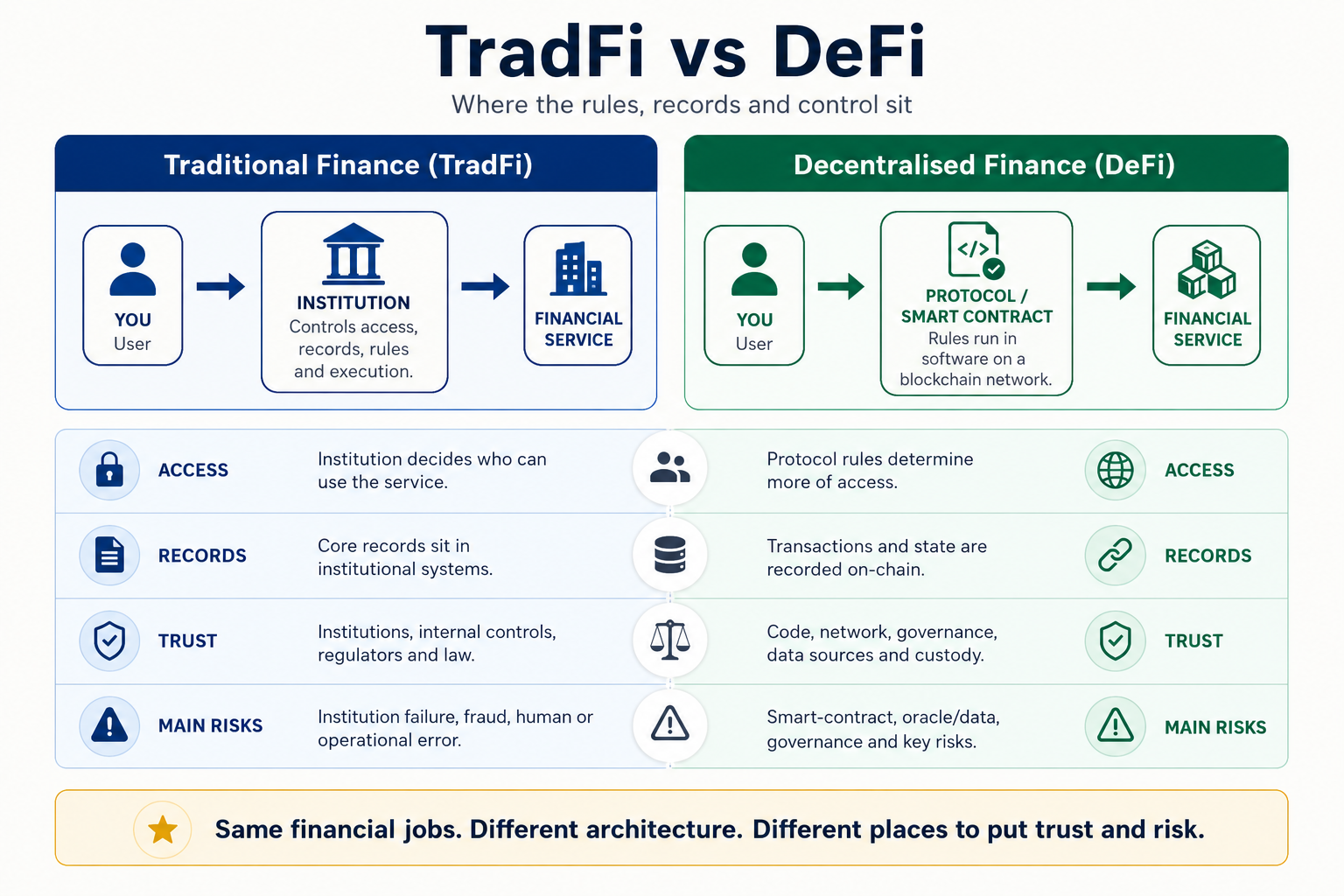
A simple comparison of how the same financial jobs can be organised differently.
How does DeFi work?
You only need to understand four things.
Blockchain — the shared ledger that records transactions and the state of the system.
Digital assets — what is moved, traded, lent or used as collateral.
Smart contracts — software rules that automatically execute when their conditions are met.
Protocols — financial services built from those rules.
Think of a smart contract simply as:
If these conditions are met, do this.
For example, instead of asking a bank officer to approve each loan, a lending protocol may allow me to deposit eligible digital assets as collateral and borrow according to rules already written into the protocol.
The bank officer is gone from that particular step.
The rules are not.
What can DeFi do?
Broadly, many of the same things Finance already does:
Exchange assets.
Lend.
Borrow.
Invest.
Provide liquidity or capital.
Create financial products.
So DeFi is not a completely different kind of Finance.
It is another way of organising and delivering financial services.
The trade-offs move too
Neither TradFi nor DeFi is automatically better.
They organise control, access, trust, protection and failure differently.
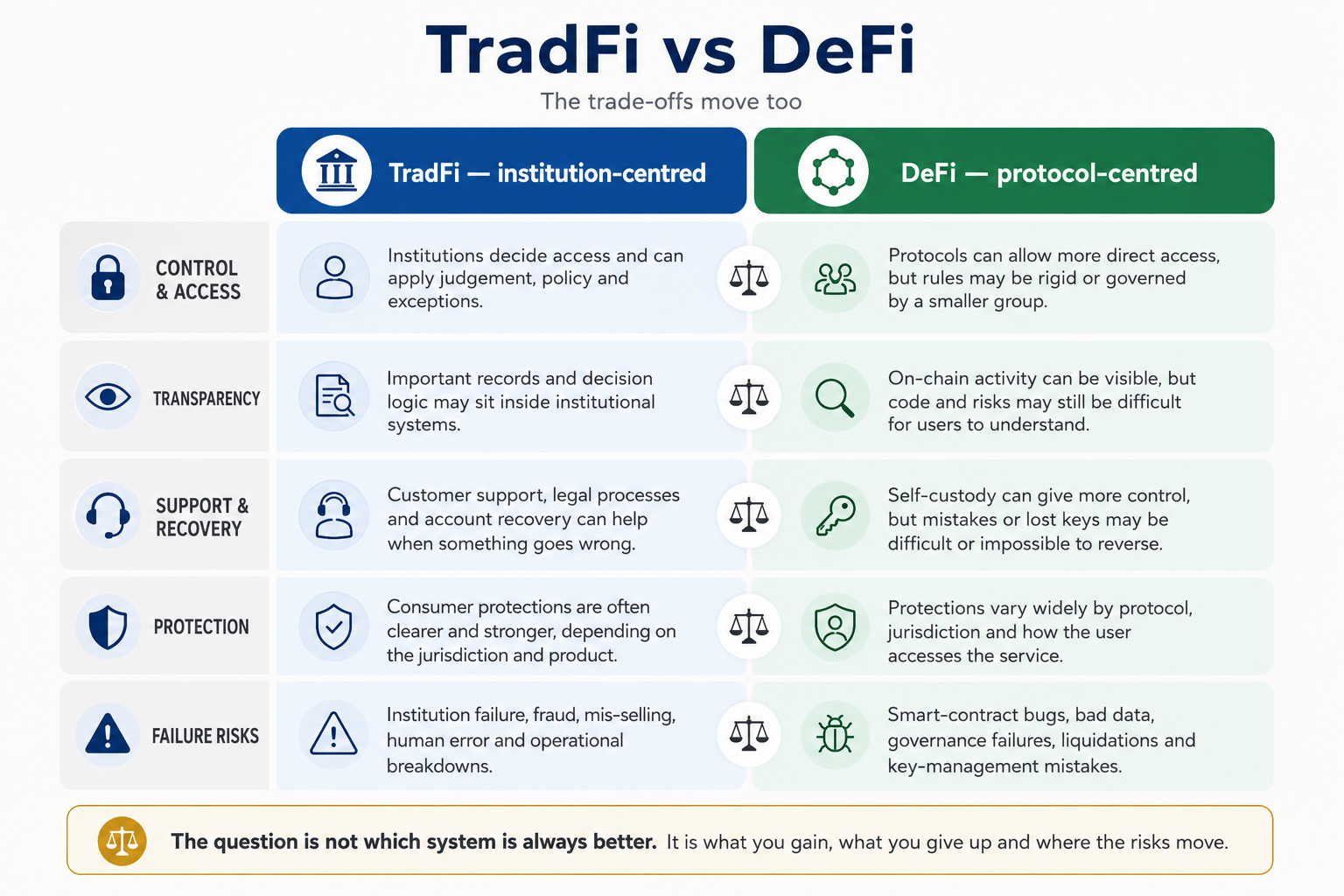
The important question is not which system is always better. It is what you gain, what you give up and where the risks move.
Traditional Finance may offer stronger legal protections, customer support and clearer ways to recover from mistakes.
But it also relies more heavily on institutions, their internal systems and their willingness or legal obligation to serve you.
DeFi can make financial rules more transparent and allow users to interact directly with protocols.
But that can also mean more responsibility sits with the user. A bad transaction may be irreversible. A lost key may mean lost assets. A smart contract, data source or governance process may fail.
The trade-offs are different.
Did DeFi remove the middleman?
Not completely.
It changed what sits in the middle.
Traditional Finance asks me to trust institutions, their systems, regulators and the law.
DeFi may instead ask me to trust code, the blockchain network, collateral, data sources, governance and my own ability to control access to my assets.
Something described as “decentralised” may also still have developers, token holders, companies or other groups with significant influence.
Decentralisation is not always all-or-nothing.
DeFi does not eliminate trust. It moves it.
The same applies to risk.
What I learned
So, what IS DeFi?
DeFi is financial services built on blockchains, where smart contracts perform some of the jobs traditionally handled by financial institutions.
The blockchains will change.
The protocols will change.
The popular products will change.
Some may disappear completely.
But the underlying question should remain useful:
Who controls the rules, where do the records live, and what am I trusting?
That is why I think the simplest way to understand DeFi is this:
DeFi does not eliminate trust or risk. It changes where we place them.
Notes & sources
- Financial Stability Board, “The Financial Stability Risks of Decentralised Finance”, 2023. Used for the broad framing of DeFi as financial services that seek to replicate functions of traditional finance while changing how those services are intermediated and governed.
- Bank for International Settlements, “DeFi risks and the decentralisation illusion”, 2021. Used for the explanation of DeFi as automated protocols on blockchains, and for the caution that decentralisation exists in degrees rather than as an all-or-nothing state.
- Bank for International Settlements, “The Technology of Decentralized Finance (DeFi)”, 2023. Used for the distinction between the financial services DeFi provides and the technological way those services are delivered.
- The original InLeo guide, “Welcome to DeFi”, preserved as source material. The rebuilt guide retains its core interest in reducing reliance on traditional intermediaries while removing time-sensitive claims about particular protocols, technologies, regulation and the future of DeFi.