At its simplest, Finance is about managing money.
In the previous guide, I wrote about what money is, why price is not the same as value, and why money is really just a tool we use to transact.
So the next question is obvious:
Now that we have money, what do we do with it?
We spend it, save it, borrow it, lend it, invest it, insure against losing it and allocate it towards different uses. Once money starts moving across people, purposes and time, Finance begins.
Forget investment banking. Forget hedge funds. Forget derivatives.
The basic problem is much simpler.
How much money do I have? What do I owe? What am I owed? What do I need next? What can I afford? What should I do with the money I already have?
Accounting helps explain what has already happened but Finance decides the next move.
Once the decision affects the future, Finance starts to involve time, risk and return.
Finance moves money through time
Suppose I have S$10,000 today and I don’t need it. You need S$10,000 today but expect to repay me next year.
I lend it to you.
I give up the use of my money today. You get to use it today. You promise to return it later, maybe with interest.
Now we have time, risk, a promise and a return.
That is Finance.
The same basic idea appears everywhere. A mortgage allows someone to use future income to buy a home today. A company raises money today to build something that may earn profits later. An investor gives up money today because he expects more value in future. Insurance collects smaller payments today so that a large financial loss can be absorbed later.
Finance allows us to move purchasing power across time.
Finance is also the art of manipulating money
We can pool money, borrow against it, lend it, invest it, insure risks around it, turn future cash flows into present value and use leverage to control more assets than the amount of cash we actually have.
If I have S$100,000 and a bank lends me another S$400,000, I can control a S$500,000 asset.
That is powerful.
It can amplify opportunity and returns.
It can also amplify losses.
Is money essentially just.. DEBT?
The more I looked at modern money, the more it started to resemble a giant web of promises.
If your bank account shows S$10,000, that deposit is an asset to you. From the bank’s point of view, it is also a liability because the bank owes you that amount.
If you borrow S$300,000 from the bank, the relationship flips. The loan is your liability and the bank’s asset.
One person’s asset can be another person’s debt.
That is why I think:
Much of modern money is debt.
Not all money throughout history. A lump of gold does not need somebody else to owe it to you.
But much of the money we use today exists as bank deposits, claims and liabilities. The Bank of England describes modern money as a special type of IOU and notes that most money in a modern economy takes the form of bank deposits.
Once I understood this, money stopped looking like piles of cash.
It started looking like a network of promises.
Banks can create money
This is where modern banking becomes more interesting.
Suppose I run a small business and the bank approves me for a S$100,000 business loan.
Before the loan, I have S$0 in that account.
Once the loan is approved, the bank credits S$100,000 into my account. My balance becomes S$100,000.
Nobody else’s account has to fall by S$100,000 for mine to increase.
At the same time, the bank records that I now owe it S$100,000.
So the loan creates two things at once:
New money: S$100,000 appears in my bank account. New debt: I owe the bank S$100,000.
If I then spend that S$100,000, the money does not disappear. It simply moves into somebody else’s bank account.
That is how bank lending can create new deposit money.
The bank creates new money by creating a new loan. The new money and the new debt appear together.
That power can fund productive businesses, homes and investment.
On the flip side, it can also help inflate bad bets.
Creating more money is not the same thing as creating more wealth.
Then the US dollar stopped being convertible into gold
In 1971, Money became increasingly abstract than it has ever been.
On 15 August 1971, US President Richard Nixon suspended the US dollar’s convertibility into gold.
In plain English:
Nixon broke the US dollar’s remaining link to gold.
The monetary system did not transform into today’s world overnight. But from then on, the US dollar no longer needed to be exchangeable for a fixed amount of gold to function as money. There were further agreements, devaluations and eventually a wider move towards floating exchange rates.
Despite so, the dollar still works because people continue to accept it.
Money works because enough of us agree that it works.
Finance then builds an enormous system on top of that agreement.
One exchange is small. Millions of exchanges become an economy.
Go back to the S$5 wanton mee.
I give the hawker money. He gives me noodles.
But the hawker also pays suppliers. Suppliers pay workers. Workers pay landlords. Landlords pay banks. Banks lend to businesses. Businesses pay distributors. Consumers buy from businesses. Governments collect taxes and spend on public services. Investors provide capital. Insurers absorb risk.
Money keeps moving.
Many of those movements also come with a promise, obligation or contract:
I pay you now. You deliver later.
I lend you this. You repay me then.
I insure this risk. You compensate me if that happens.
One exchange is a transaction.
Millions of connected exchanges form an economy.
Finance helps those exchanges happen across different people, purposes and points in time.
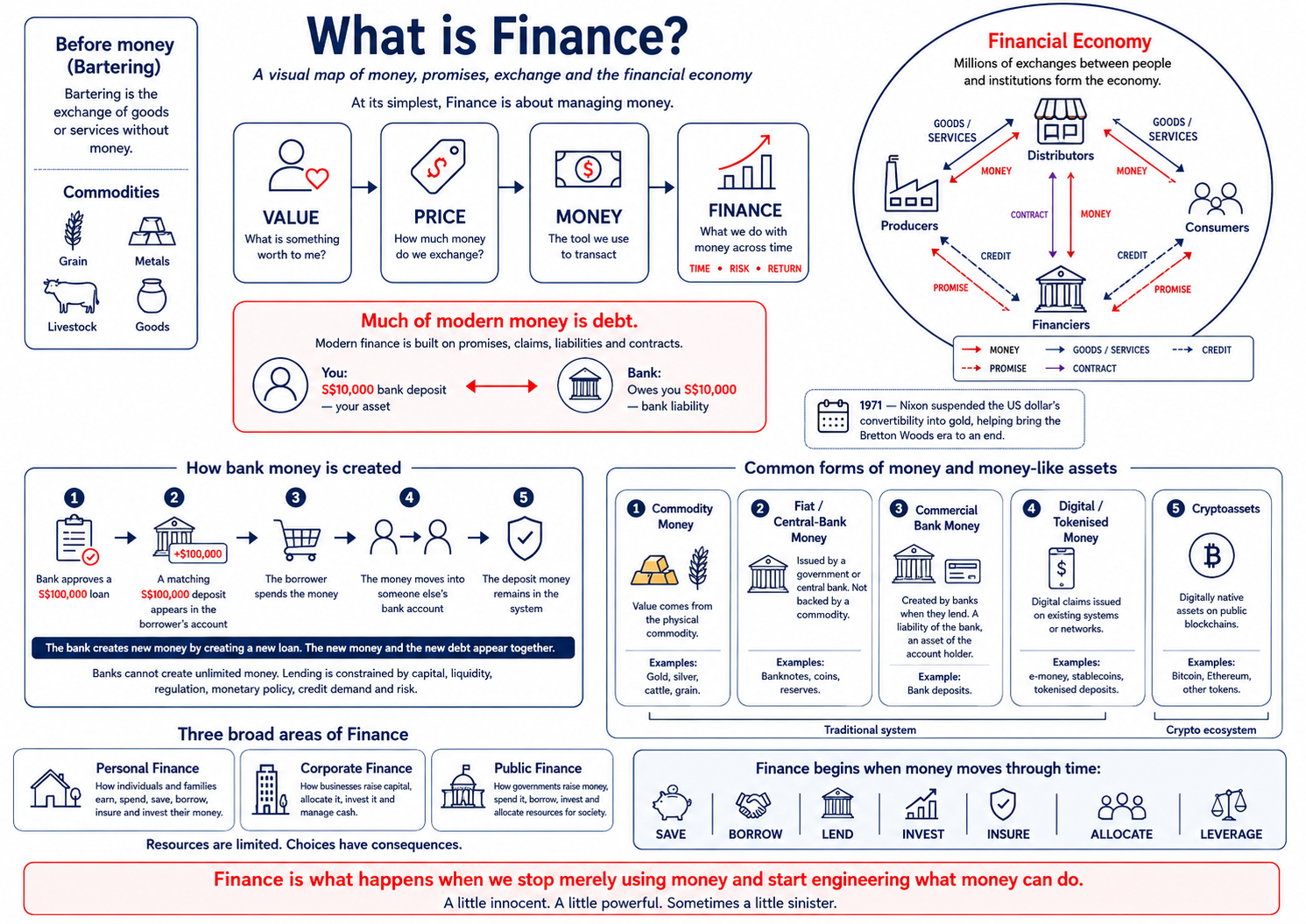
A visual map of money, promises, exchange and the financial economy.
The three broad areas of Finance
Personal Finance
Personal Finance is about how individuals and families earn, spend, save, borrow, insure and invest their money.
Corporate Finance
Corporate Finance is about how businesses raise capital, allocate it, manage cash, fund investments and decide how to create returns.
Public Finance
Public Finance is about how governments raise money, spend it, borrow, invest and allocate resources for society.
Different scale.
Same basic problem:
Resources are limited. Choices have consequences.
Is money really the root of all evil?
People often say:
“Money is the root of all evil.”
The actual warning is about the love of money, not money itself. A common modern translation reads:
“For the love of money is a root of all kinds of evil.”
Money itself does not make decisions. People do.
Finance gives people increasingly powerful tools to spend, borrow, invest, leverage and allocate money. Those tools can build homes, businesses and infrastructure. They can also magnify greed, fear, overconfidence and bad judgment.
Finance is not evil.
But Finance amplifies.
What I learned
So, what IS Finance?
Finance helps us decide what money should do next — how to save it, borrow it, lend it, invest it, insure it, allocate it and leverage it across people and time.
It can create opportunity.
It can also amplify risk.
So Finance, to me, is essentially:
The art of manipulating money from a tool of exchange into a tool of leverage, risk and possibility.
Sources and notes
- Bank of England, “Money in the modern economy: an introduction”, 2014. Useful for the description of modern money as a type of IOU, the role of bank deposits and the relationship between assets and liabilities.
- Bank of England, “Money creation in the modern economy”, 2014. Important correction to the simple textbook reserve-multiplier story: commercial banks create deposit money through lending rather than simply lending out pre-existing deposits.
- Bank of England, “How is money created?”, updated 2019. Plain-English explanation of how a bank loan creates a matching deposit and why banks cannot create unlimited money.
- Office of the Historian, U.S. Department of State, “Nixon and the End of the Bretton Woods System, 1971–1973”. Used for the historical account of Nixon’s 15 August 1971 suspension of the dollar’s convertibility into gold and the subsequent breakdown of the Bretton Woods fixed-exchange-rate system.
- Office of the Historian, U.S. Department of State, Foreign Relations of the United States, 1969–1976, Volume XIX, Part 2, Document 89. Primary-source wording confirming Nixon’s direction that dollar convertibility into gold or other reserve assets be suspended.
- The original InLeo guide, “What is Finance?”, preserved as source material rather than treated as authoritative. Its original financial-economy diagram provided the conceptual starting point for the rebuilt visual.