Why does a plate of wanton mee cost S$5?
Not because the noodles contain S$5 worth of some universal substance called value.
The hawker is willing to give up the noodles for S$5.
I am willing to give up S$5 for the noodles.
Deal.

A plate of wanton mee. Photo: ProjectManhattan / Wikimedia Commons / CC BY-SA 3.0.
That tiny transaction contains almost everything I want to explain about money.
The price is S$5.
But the value of that bowl is different to different people.
If I am starving, it may feel like a fantastic use of S$5.
If I have just eaten, I may not pay S$1 for another bowl.
Same noodles.
Same price.
Different value.
Price is not the same thing as value.
That sounds simple.
I think it changes how we should think about money — and eventually, wealth.
But first, a very short history lesson.
Before money looked like money
The history of money is messy. Humans did not all move neatly from barter to coins to notes in one clean sequence.
For what I am trying to understand, that is not the important part.
The important part is that long before we had modern money, people already needed ways to keep track of who had what, who owed what and what things were worth.
Some of the earliest surviving writing from Mesopotamia was used to record economic information.
This clay tablet from around 3100–2900 BCE records deliveries and distributions of grain.

An administrative clay tablet concerning barley and emmer, ca. 3100–2900 BCE. The Metropolitan Museum of Art. Image via Wikimedia Commons, CC0.
No dollar sign.
No banknote.
No PayNow.
Still, people were already keeping score.
That is the first thing worth remembering.
Money did not create value.
People already valued food, land, labour, animals, tools and all sorts of other things.
Money made it easier to put a number on those things and exchange them.
Coins made the number easier to carry
Imagine having to weigh a piece of metal every time you wanted to buy something.
Is it really silver?
How much does it weigh?
Is the scale correct?
Very troublesome.
Standardised coins made things easier. A recognised coin could carry a known weight and denomination, so people did not have to start from zero for every transaction.
A Lydian gold stater from around 560–546 BCE is one early example.

A Lydian gold stater, ca. 560–546 BCE. The Metropolitan Museum of Art. Image via Wikimedia Commons, CC0.
The gold itself had value.
But the coin was useful because other people could recognise what it was supposed to represent.
Then humans took the idea further.
Then even the valuable object became unnecessary
Look at this Chinese banknote from 1375.
It represented one guan — a string of 1,000 cash coins.
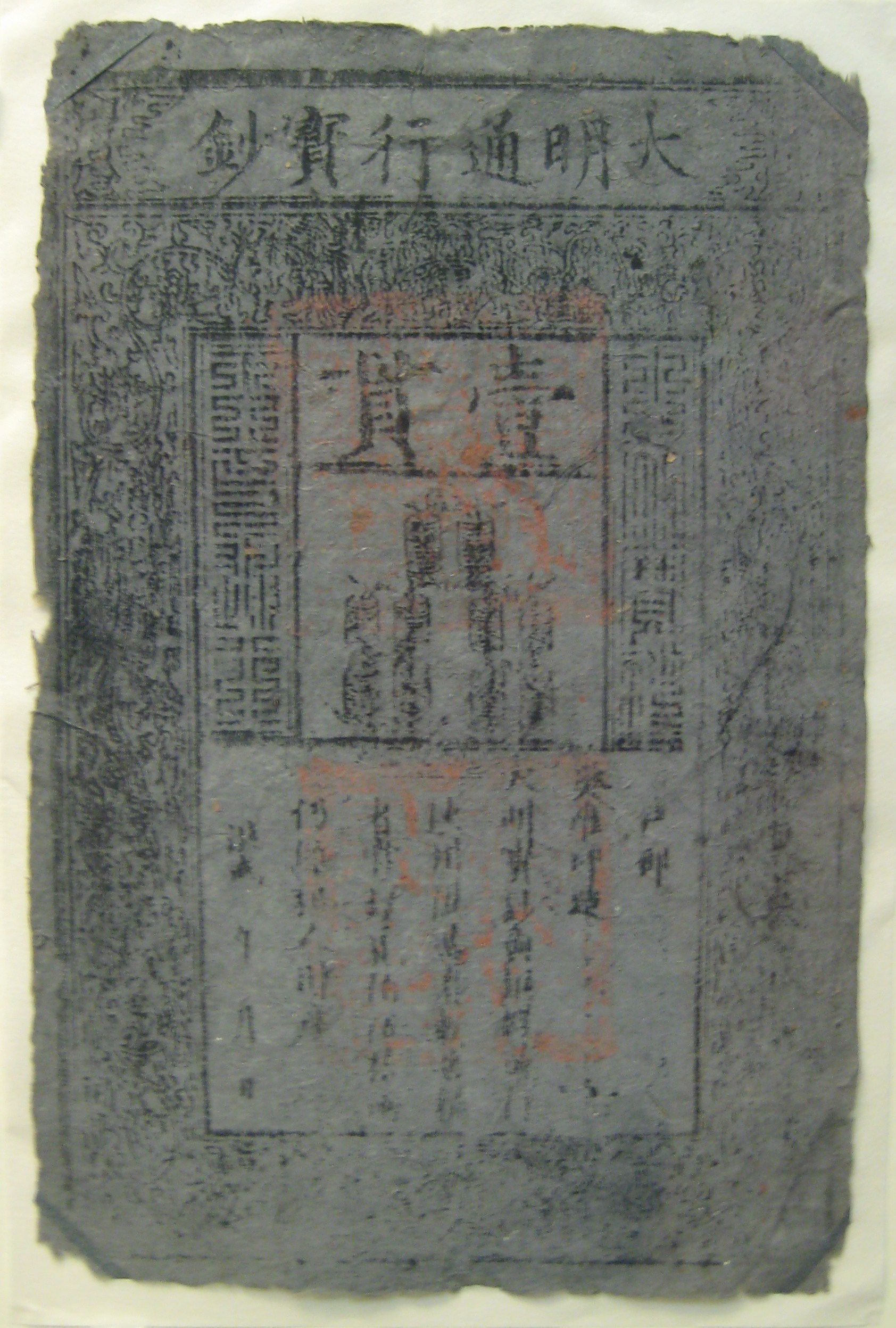
A Ming dynasty one-guan banknote from 1375. British Museum. Image via Wikimedia Commons, CC0.
The paper itself was obviously not worth 1,000 metal coins.
That was the point.
You did not need the object itself to contain all the value.
You needed people to accept what the object stood for.
Today we have taken this even further.
I can work for a month and receive no coins and no notes.
A number simply goes up in my bank account.
I am perfectly happy with that because I know I can use that number to pay my mortgage, buy groceries or transfer money to somebody else.
Most money in a modern economy is now held as bank deposits rather than physical cash.
Money has become so abstract that most of us barely touch it anymore.
And yet it works.
Money can even be a giant rock
This is one of my favourite examples.
On the Pacific island of Yap, large stone discs known as rai were used as money for important transactions.
Some were so large that moving them around every time ownership changed would have been ridiculous.
So they often did not move.
People simply knew who owned them.

Stone money from Yap. Photo: Daderot / Wikimedia Commons / CC0.
Think about that for a moment.
A giant rock can be money.
A piece of paper can be money.
A gold coin can be money.
A number inside a bank’s computer can be money.
The thing itself keeps changing.
So the thing cannot be the important part.
What matters is much simpler:
Can I use it to pay you, and will you accept it?
That is really what money gives us — a common way to transact even when we value things differently.
What money actually helps us do
For me, there are three useful things to understand.
Money lets us put prices on very different things.
A haircut, a laptop, one hour of work and a plate of wanton mee can all be expressed in dollars.
Money lets us exchange without needing a perfect swap.
I do not need to find a hawker who wants Finance work before I can buy lunch from him.
And money lets us save some spending power for later.
I can work today and use part of what I earn next month or next year.
That is why money is such a powerful invention.
It makes exchange much easier.
But there is one thing money cannot do for us.
It cannot decide what something is worth to me.
Price is not the same thing as value
This is the part I care about most.
Price is public.
Value is personal.
The menu may say S$5 to everybody.
But S$5 of wanton mee does not create the same value for everybody.
The same is true for almost everything else.
A S$200 pair of running shoes may be ridiculous to someone who hates running and completely reasonable to someone who runs four times a week.
A golf lesson may be worth more to me than a nice dinner.
Someone else would choose the dinner every single time.
Neither person is necessarily wrong.
We are simply valuing different things.
Money helps us settle the transaction.
It does not settle the argument about what is worth having.
That distinction matters because we often blur the two together.
Something is expensive, therefore it must be valuable.
Something is cheap, therefore it must be less valuable.
Someone has more money, therefore that person must be wealthier in every meaningful sense.
Not necessarily.
A price is a number.
Value requires a person.
And this changes how I think about wealth
I am a Finance person. I am not going to tell you that money does not matter.
Of course it matters.
If my bills are due, being rich in friendship is not going to pay them.
More money can give me security.
Options.
Better healthcare.
A safer home.
Time away from work.
Experiences.
The ability to help my family.
The freedom to walk away from something I no longer want to tolerate.
Those things are valuable to me.
But notice what happened there.
I did not actually want the money for the money.
I wanted what the money could do.
That is where my definition of wealth starts to change.
If money is a tool for getting things we value, then simply accumulating more of the tool cannot be the entire objective.
Otherwise there is no finish line.
S$100,000 becomes S$1 million.
S$1 million becomes S$2 million.
Then S$5 million.
Then more.
The number can keep going forever.
But what is the number for?
That question is harder.
And much more important.
What I learned
I started by wanting to understand the history of money.
What survived was something much simpler.
Money is not value.
It is a very useful way for us to put prices on things, exchange them and save spending power for later.
But price and value are not the same thing.
The price of something can be written on a menu.
Its value depends on the person looking at the menu.
And if different people value different things, then wealth cannot mean exactly the same thing to everybody either.
That is why I want to start the Finance Library here.
Before asking how to make more money, invest it better or accumulate more wealth, I want to ask a more basic question:
What do I actually want the money for?
Money gives us the mechanism for exchange. Finance begins when we start deciding what that money should do across people, purposes, risk and time.
Sources and notes
- Caroline Humphrey, “Barter and Economic Disintegration”, Man 20(1), 1985, pp. 48–72, DOI: 10.2307/2802221. Included for the narrow point that the familiar barter-first story should not be treated as a universal history of money.
- The Metropolitan Museum of Art, “Cuneiform tablet: administrative account concerning the distribution of barley and emmer”, ca. 3100–2900 BCE. The Met notes that early writing in southern Mesopotamia was used primarily to record and store economic information.
- The Metropolitan Museum of Art, “Gold stater”, Lydian, ca. 560–546 BCE.
- British Museum, Ming dynasty banknote, dated 1375 and denominated at one guan, or a string of 1,000 cash coins.
- Bank of England, “Money in the modern economy: an introduction”, 2014. Useful for the modern distinction between physical currency and bank deposits, and the observation that most modern money is held as bank deposits.
- Federal Reserve Bank of St. Louis, “Here’s What Makes Money, Money”, on the characteristics of money and Yap stone money, including transfers of ownership without physically moving the stones.
- Smithsonian Institution, “The Evolution of Money, From Feathers to Credit Cards”, for additional historical examples of the different objects societies have used as money.
Image notes
- Wanton mee photograph: ProjectManhattan, Wikimedia Commons, CC BY-SA 3.0.
- Sumerian administrative tablet: The Metropolitan Museum of Art, Wikimedia Commons, CC0.
- Lydian gold stater: The Metropolitan Museum of Art, Wikimedia Commons, CC0.
- Ming banknote photograph: Wikimedia Commons, CC0.
- Yap stone money photograph: Daderot, Wikimedia Commons, CC0.


